Satellite Images Reveal Chinese Missile Base Expansion in Tibet
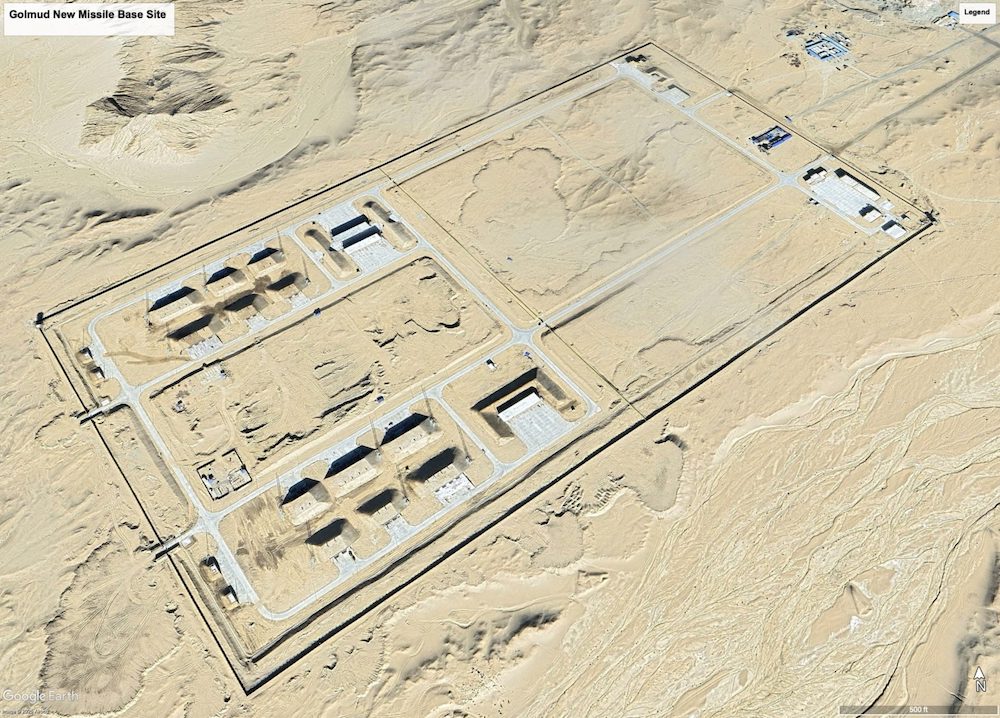
Satellite image showing a new PLA Rocket Force base near Golmud (Photo: The Diplomat)
Satellite images of new installations near Golmud in Qinghai province reveal a growing military presence of China’s Rocket Force (PLARF) on the Tibetan Plateau. The facilities include multiple launch platforms, large hangars for transporter-erector-launchers (TELs) and various support structures, indicating the formation of a new missile brigade under PLARF Base 64.
Construction and Capacity
Construction of the base began around 2020 and has accelerated since 2022, with satellite imagery showing an expanding network of launch and support buildings. Military analysts estimate that the Golmud installation could ultimately house 24 to 36 missile launchers, comparable to other major PLARF bases in China’s strategic command.
The complex could be linked to the 647th Missile Brigade already stationed in Xining, which is known to operate DF-26 intermediate-range ballistic missiles. The DF-26 has an estimated maximum range of 4,000 kilometres and can carry both nuclear and conventional payloads.
Strategic Location
The new facilities are situated near Golmud on the high-altitude Qinghai-Tibet Plateau, enabling “rapid deployment of missiles through western China and potentially far beyond.” The base lies just 900 kilometres from the Indian border, allowing China to rapidly mobilise missile units in the event of conflict.
From Qinghai, DF-26 missiles can reach major Indian military hubs, American presence in the Pacific, and installations in the Indian Ocean. The 4,000-kilometre range means the PLARF can strike air bases and logistics hubs throughout India and the northern Indian Ocean from this location.
Operational Readiness
During 2024 and 2025, field training and live-fire exercises took place, indicating that the new unit is approaching operational readiness. Defence observers reported regular large-scale military exercises in the Golmud region during this period.
The Pentagon projected that China could possess 1,000 nuclear warheads by 2030. The dual-capable configuration of the DF-26 “complicates escalation control, particularly during crises along the China-India border or during Taiwan scenarios.”
Broader Implications
The expansion of the missile base in Tibet is part of a broader pattern of Chinese militarisation of the Tibetan Plateau. The strategic high-altitude location offers China military advantages for both regional deterrence and power projection into South and Central Asia.
The development has raised concerns among India and other regional actors about the shifting military balance in the region. The DF-26’s ability to switch between nuclear and conventional warheads complicates India’s escalation calculus in the event of a border conflict.
Sources
- Satellite images reveal China's missile base expansion near Golmud, Qinghai
- China Expands Missile Forces in Tibetan Plateau
- China Expands Missile Base in Tibet, Intensifying Regional Tensions
- Chinese Missile Buildup In Tibet Sparks Indian Concerns
- The PLARF Challenge: Why India's Integrated Rocket Force Cannot Wait