Tibetans in exile choose new leadership: democracy as an act of resistance
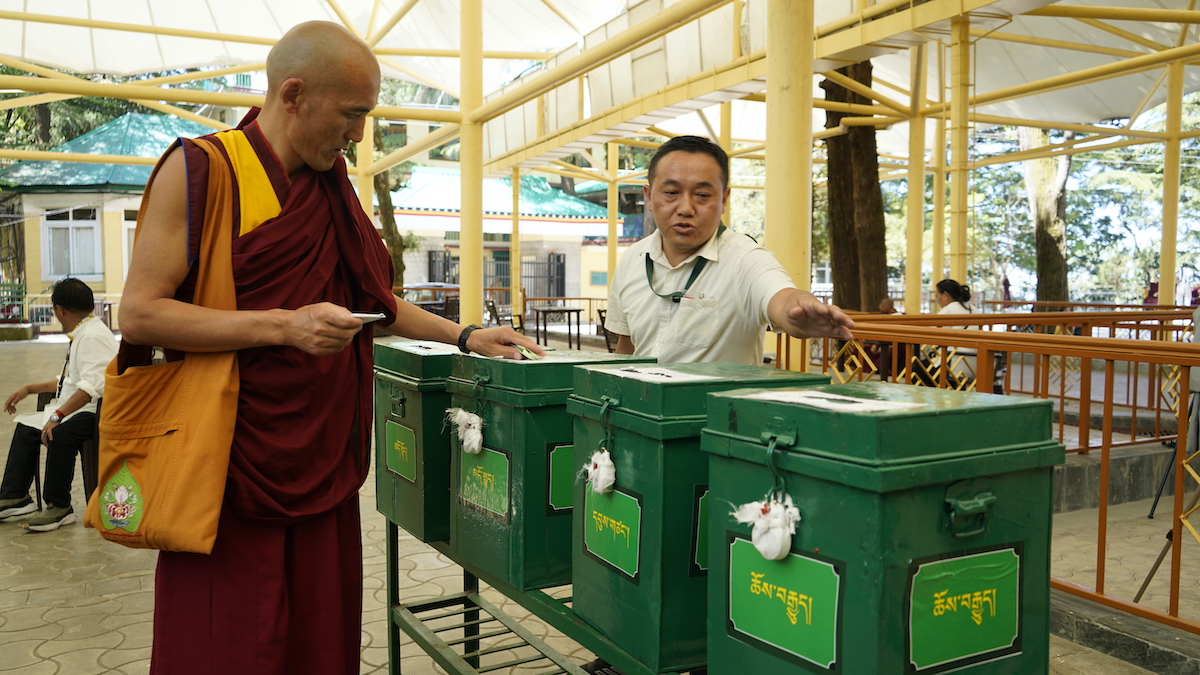 A Tibetan monk casts his ballot at the Main Tibetan Temple polling station during the final round of elections, April 26, 2026 (Phayul photo/Kunsang Dorji)
On April 26, 2026, Tibetans in exile across the world went to the polls. In 27 countries, managed by 1,737 election officials across 309 polling stations, they elected their political leader — the Sikyong — and the 45 members of the Tibetan Parliament in Exile. In Dharamshala alone, 11 polling stations were active. These elections are more than an organizational achievement: they are a political act.
Democracy as the Dalai Lama’s legacy
The democratization of Tibetan political life is one of the most far-sighted reforms carried out by His Holiness the 14th Dalai Lama shortly after his arrival in exile in the early 1960s. He led his community away from a theocratic system and laid the foundations for a democratic governance structure in exile — with direct elections for both the Sikyong and the parliament.
That legacy has been carried forward by the Tibetan community for more than six decades now, despite all the logistical challenges of a diaspora spread across dozens of countries.
Penpa Tsering re-elected
The incumbent Sikyong, Penpa Tsering, secured more than 61 percent of the vote in the preliminary round in early February and was thereby re-elected before the final round even took place. His re-election ensures continuity in leadership at a time when the Tibetan cause is once again prominently on the international agenda.
A total of 93 candidates stood for seats in the parliament, which elects representatives from traditional provinces, religious communities, and the diaspora. Worldwide, more than 91,000 Tibetans were registered as eligible voters.
Chief Election Commissioner Lobsang Yeshi stressed that Tibetan democratic institutions have been operating successfully for sixty years, and dismissed criticism from China: “A one-party system lacking democratic processes does not hold the legitimacy to comment on democratic practices.”
Elections in the Netherlands
Tibetan voters in the Netherlands also participated in this democratic process. Under the supervision of the local election committee — consisting of eight committee members and three independent observers — voting in Amsterdam proceeded in an orderly and transparent manner.
Voters in the Netherlands chose from five candidates for the European constituency: the two candidates with the most votes will take their seats in the Parliament in Exile as representatives of the European Tibetan community.
Voter turnout was, however, lower than expected. This points to an ongoing challenge: awareness within the community about the importance of active participation in the democratic process deserves greater attention. Voting is not only a right, but also a responsibility — a responsibility that carries even greater weight given the circumstances inside Tibet itself.
There are also organizational lessons to be drawn. Greater involvement of external, non-Tibetan observers and broader media outreach would strengthen transparency and increase the international visibility of the Tibetan democratic process.
A powerful contrast
Inside Tibet, participation in free and fair elections is impossible. The Tibetan population is denied any form of political self-determination. That is precisely why these elections in exile are more than an internal organizational moment: they are a visible and principled statement about what the Tibetan people want and who represents them.
On May 31, 2026, the newly elected Sikyong and the 45 members of parliament will take their oath of office in Dharamshala, formally marking the start of a new term. Tibet Support Group Netherlands closely follows these developments and continues to support the Tibetan people’s struggle for freedom and democracy.