Bulldozing Tibetan Identity begins at Larung Gar
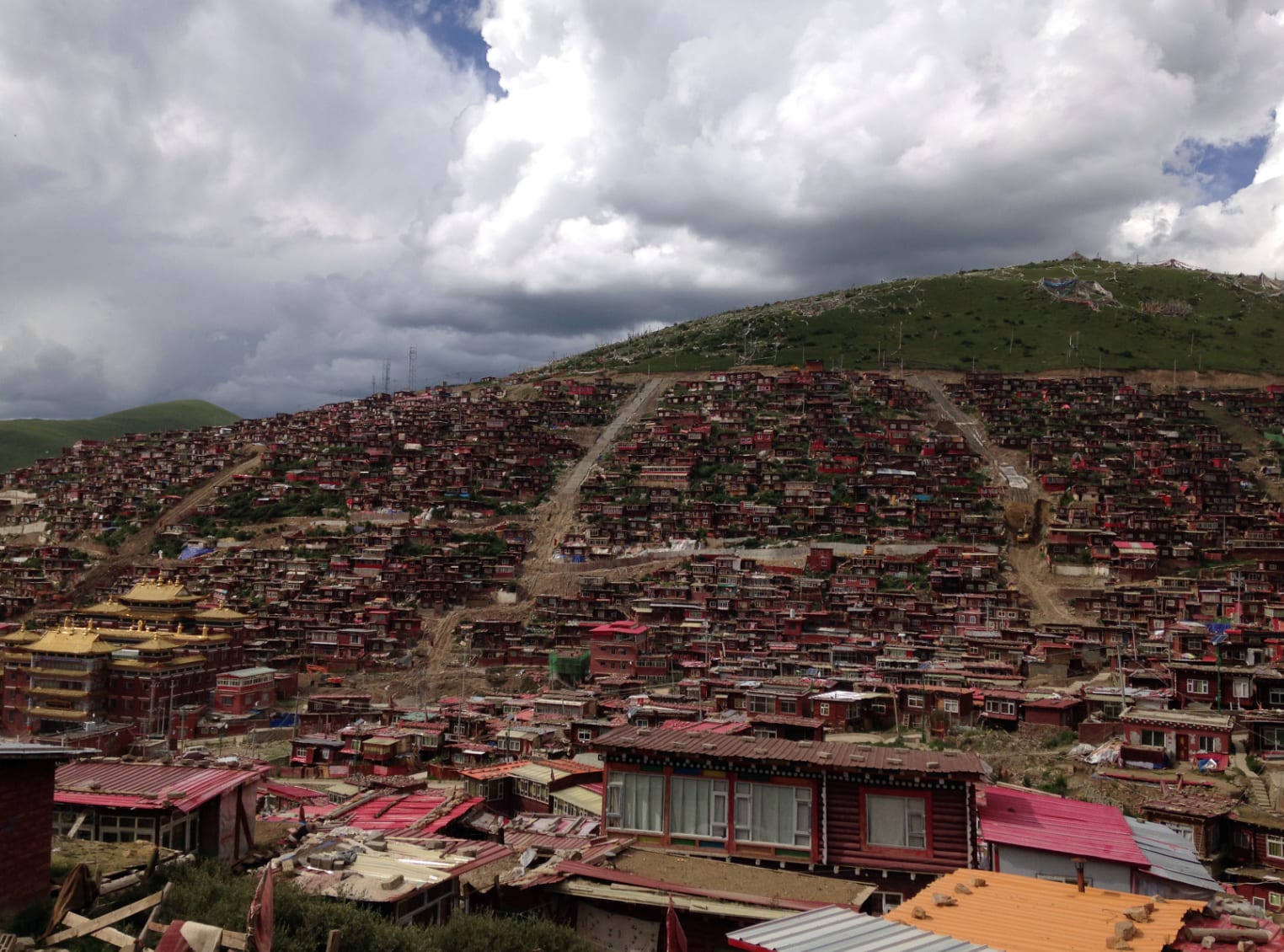
Larung Gar during an earlier demolition wave: the bare strips carved through the settlement show where dwellings were removed. No public images of the current work exist — the demolitions take place at night and photography is forbidden. (Archive image, TCHRD)
At Larung Gar, the Chinese authorities are giving a foretaste of what the Ethnic Unity Law, in force since 1 July, means for Tibet. In mid-July, Chinese demolition contractors began large-scale work at this monastic settlement, one of the largest and most important centres for Tibetan Buddhist learning in the world. At least 1,060 dwellings belonging to monks and nuns have been marked for demolition.
The work began around 13 July 2026 and, according to sources, is being carried out mainly at night — presumably to hinder public reporting, documentation, and satellite monitoring. Sections of the site are cordoned off with fencing and water is sprayed to mask clouds of dust. Photography and filming are banned, freedom of movement is restricted, and surveillance is heavy. By 15 July, the first six dwellings had been destroyed; by 21 July the demolitions were continuing unabated. Serthar, the county in which the academy lies, remains heavily closed off to visitors.
That the demolition is hidden from view is not incidental but deliberate. Accordingly, no public photographs of this round of demolitions exist: the images accompanying this article are from earlier campaigns.
A law that legalises erasure
That the bulldozers moved in less than two weeks after the Law on the Promotion of Ethnic Unity and Progress took effect is no coincidence. The law anchors the forced assimilation of Tibetans, Uyghurs, and other peoples in legislation, and criminalises criticism of it — including beyond China’s borders. Larung Gar is the first major site where it becomes visible what that law means in practice: not a policy intention on paper, but bulldozers in the dark.
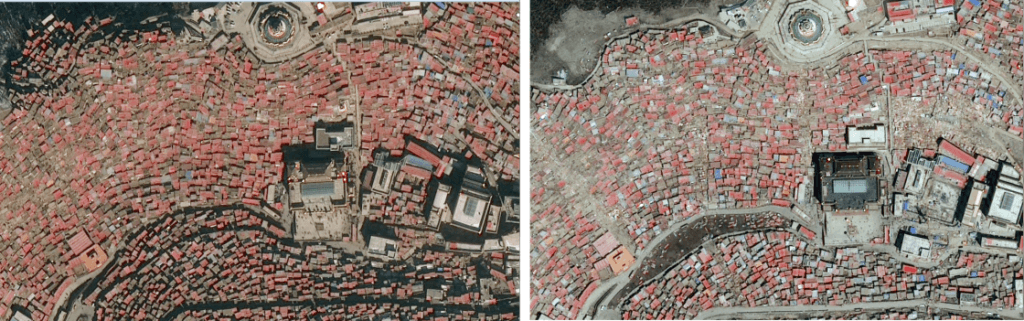
Satellite imagery exposed the scale of the 2016–2017 demolition wave — precisely the kind of documentation the Chinese authorities are now trying to prevent.
More than twenty years of dismantling
Larung Gar was founded in 1980 by the eminent Tibetan Buddhist master Khenpo Jigme Phuntsok, with the support of the then Panchen Lama, to revive Buddhist scholarship in the wake of the Cultural Revolution. It grew into a unique centre for study and meditation and for the preservation of the Tibetan language, religion, and culture. Thousands of monks, nuns, and lay practitioners gathered there, among them many Chinese Buddhists. Larung Gar thus became a powerful symbol of the vitality and reach of Tibetan Buddhism.
It was precisely that appeal that made the academy suspect in Beijing’s eyes. In 2001, the dwellings of an estimated 8,000 residents were demolished to halve their number. When the community grew again to some 10,000 people, further expulsions followed in 2016 and 2017 and nearly 5,000 dwellings were destroyed. Since 2019 the participation of Chinese Buddhists has been restricted, and since November 2021 they have been segregated from the Tibetan residents. Every time the community recovers, the bulldozers return.
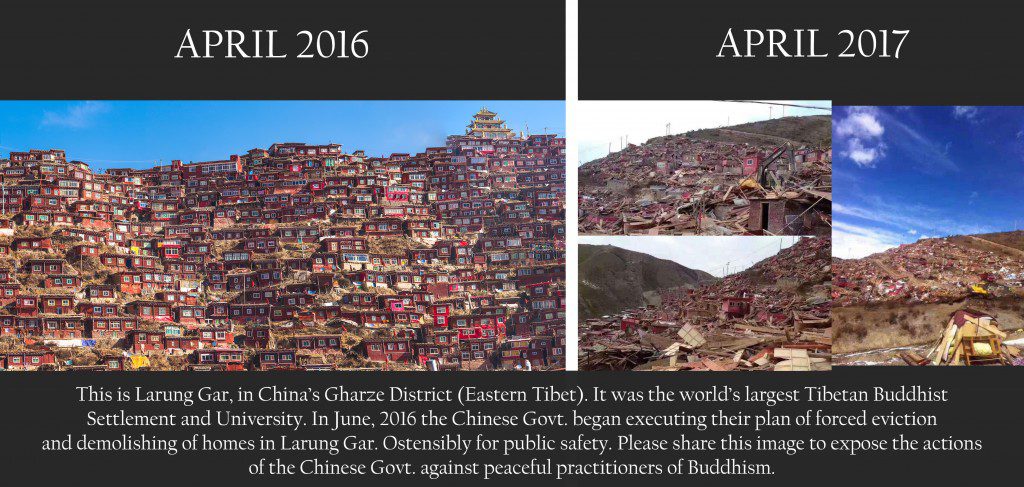
April 2016 and April 2017: the effect of a single demolition wave on the community. The same pattern is now repeating itself, but out of sight of any camera.
In February 2017, six independent UN experts warned that the measures violate international law and amount to “concerted attacks on tangible and intangible cultural heritage”.
An attack on a living community
The latest demolitions are about far more than the destruction of buildings. These are not derelict structures making way for urban renewal, but the homes of people who live there to study and to pray. This is a direct attack on a living spiritual community, on the religious freedom of Tibetans, and on the survival of a unique culture — a flagrant violation of rights that China claims to guarantee in its own constitution.
Tibet Support Group Netherlands is deeply concerned by this development and calls on the international community to speak out clearly and forcefully. We call on the Dutch government and the European Union to confront China directly over the demolitions at Larung Gar and over the Ethnic Unity Law that makes them possible. The demolitions and forced evictions must be halted immediately.
Tibet Support Group Netherlands works for the rights, culture, and political representation of the Tibetan people.
Sources
- International Campaign for Tibet – Famed Larung Gar Buddhist academy in eastern Tibet faces new round of demolitions
- Phayul – China targets more than 1,000 residences in latest Larung Gar demolition drive
- TCHRD – Chinese Authorities Resume Demolition at Larung Gar, the World's Largest Tibetan Buddhist Institute
- Tibetan Review – China launches new demolitions at Larung Gar Buddhist centre as its ethnic unity law came into force
- Central Tibetan Administration – Bulldozing Tibetan Identity: China Resumes Brutal Demolitions at Larung Gar
- Tibet Post International – Chinese authorities set to demolish 1,060 dwellings of monks and nuns in Larung Gar