Tibetan leadership challenges Beijing over historical claims on Dalai Lama succession
CTA announces conference to expose lack of evidence for Chinese control over the reincarnation system
November 3, 2025
President of the Central Tibetan Administration Penpa Tsering has announced plans for an international conference to challenge one of Beijing’s most audacious claims: that an atheistic, communist government has the authority to determine the reincarnation of the highest spiritual leaders of Tibetan Buddhism.
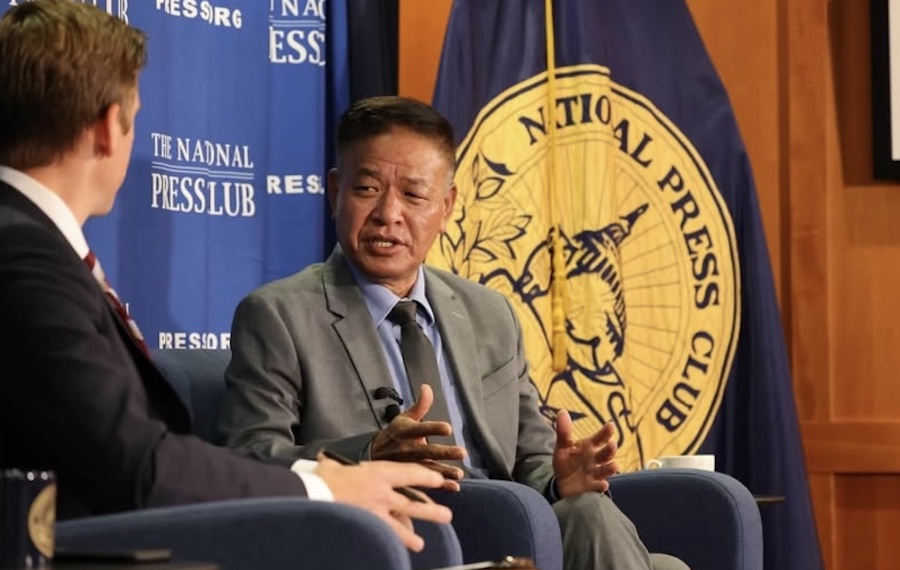
During a speech on October 30 at the National Press Club in Washington D.C., Tsering directly confronted China’s assertion that a Qing dynasty decree from 1793—prescribing the use of a “Golden Urn” in the selection of reincarnated lamas—gives Beijing control over the recognition of the next Dalai Lama.
“There is no documentary evidence” to support the Chinese narrative, Tsering declared, announcing that the upcoming conference will systematically examine the historical sources that Beijing claims give it legitimacy to interfere in sacred Buddhist traditions.
The statement represents an escalation in the Central Tibetan Administration’s pushback against China’s decades-long campaign to control Tibetan spiritual succession—a campaign that many observers see as preparation for Beijing to install its own candidate as the 15th Dalai Lama when the current spiritual leader, now 90 years old, passes away.
The Battleground of Faith versus Politics
At the core of this conflict is a fundamental question: Can a government that officially rejects religious belief dictate the spiritual succession of one of the world’s oldest Buddhist traditions?
“The reincarnation system is a matter of faith, not a political instrument,” Tsering emphasized. “And the Tibetan people will determine the future of the Dalai Lama lineage—not Beijing.”
This is not empty rhetoric. Since 2007, China has enforced “Order No. 5,” officially titled “Measures for the Management of the Reincarnation of Living Buddhas in Tibetan Buddhism,” which requires all Buddhist temples to submit a “Reincarnation Application” to government agencies before a tulku—a reincarnated teacher—can be recognized.
The regulation establishes a chilling bureaucratic hierarchy: reincarnations with “relatively great impact” require provincial approval; those with “great impact” need approval from the State Administration for Religious Affairs; and those with “particularly great impact”—clearly referring to figures such as the Dalai Lama—must be approved by China’s State Council.
In other words: the Chinese Communist Party—an organization whose fundamental ideology is atheistic materialism—has declared itself the ultimate arbiter of spiritual reincarnation.
The Golden Urn: Myth versus History
Beijing’s historical justification centers on the Golden Urn, a ritual object introduced by Emperor Qianlong in 1793 after the Sino-Nepalese War. According to the system, names of reincarnation candidates would be engraved on ivory or metal tablets, placed in a golden urn, and drawn by lot during prayers before the Jowo statue in the Jokhang Temple in Lhasa.
China presents this 232-year-old decree as establishing permanent imperial—and by extension modern Chinese governmental—authority over Tibetan spiritual succession.
But Tsering’s planned conference will highlight what historians have long documented: the Golden Urn was rarely used, inconsistently applied, and often bypassed with imperial consent.
“Were the eight Dalai Lamas before 1793 then not authentic?” Tsering asked rhetorically during his speech at the National Press Club, exposing the logical absurdity of Beijing’s position. If the Golden Urn is essential for legitimacy, then every Dalai Lama recognized before its introduction—the majority of the lineage—would be invalid.
Even after 1793, the use of the urn was sporadic. The 14th Dalai Lama—the current spiritual leader—was explicitly exempted from the Golden Urn process when he was recognized in 1940, with the full consent of the Chinese authorities at the time.
The only case in which the Golden Urn “was solely manipulated,” as Tsering put it, was “in the case of the China-appointed 11th Panchen Lama”—a reference to Beijing’s abduction in 1995 of six-year-old Gedhun Choekyi Nyima, the Dalai Lama-recognized Panchen Lama, and the installation of its own candidate, Gyaltsen Norbu. Gedhun Choekyi Nyima, now in his thirties, has not been seen in public since his disappearance nearly 30 years ago—making him one of the world’s longest-held political prisoners.
Tibetan Self-Determination versus Chinese Control
The Central Tibetan Administration has made clear that Tibetan Buddhist tradition—not Chinese political decrees—will govern succession planning.
Tsering confirmed that His Holiness the Dalai Lama has established that the Gaden Phodrang Trust will oversee the selection of his successor, in consultation with senior Buddhist leaders, monasteries, and traditional oracles. This process honors centuries-old Tibetan Buddhist practices while completely excluding Beijing’s interference.
The Dalai Lama himself has previously stated that he may choose not to reincarnate at all, or may be reborn outside Chinese-controlled territory—possibly as a woman, or even in a non-traditional form. These statements are designed to preempt Beijing’s inevitable attempt to install a puppet “15th Dalai Lama” who would serve Chinese interests rather than Tibetan spirituality.
China’s response has been predictably authoritarian: if the Dalai Lama does not reincarnate according to Chinese government procedures, Beijing will simply not recognize his successor as legitimate.
This Orwellian stance—an atheistic government declaring which spiritual leader is “real”—reveals the true nature of China’s claims: this has nothing to do with respecting Tibetan tradition or Buddhist theology, and everything to do with political control over the Tibetan population.
Growing International Support for Tibetan Spiritual Autonomy
Tsering’s announcement comes amid increasing international recognition that Beijing’s interference in Tibetan spiritual affairs constitutes a violation of religious freedom.
In 2020, the United States enacted legislation authorizing sanctions against Chinese officials who interfere with the selection of Tibetan Buddhist leaders, including the successor of the Dalai Lama. The law explicitly states that decisions regarding Tibetan Buddhist leader reincarnations lie exclusively within the authority of the Tibetan Buddhist community.
European countries have made similar pledges in support of Tibetan spiritual autonomy, signaling that Western democracies view China’s reincarnation control efforts as a human rights issue rather than an internal Chinese affair.
These diplomatic developments reflect a growing awareness that Beijing’s succession plans for the Dalai Lama are part of a broader pattern of religious persecution in China—from the mass detention of Uyghur Muslims in Xinjiang to the systematic suppression of Christianity, Falun Gong, and other faith systems perceived as threatening to Communist Party control.
What Happens Next?
Details of the Central Tibetan Administration’s conference—including specific dates, location, and participants—have yet to be announced. The gathering is expected to bring together historians, Buddhist scholars, legal experts, and Tibet advocates to systematically document the historical inaccuracy of China’s Golden Urn claims.
The conference represents more than an academic exercise. By methodically dismantling Beijing’s historical narrative, the CTA aims to delegitimize China’s claims in international forums and strengthen support for Tibetan self-determination in spiritual matters.
For the Tibetan people—both the approximately six million living under Chinese occupation and the diaspora scattered across the world—the stakes could not be higher. The reincarnation of the Dalai Lama is not merely a religious matter; it strikes at the heart of Tibetan cultural identity, continuity, and resistance to cultural erasure.
Beijing understands this, which explains why it has invested enormous political capital in establishing control over the succession process. China’s goal is transparent: to install a compliant “Dalai Lama” who will bless Chinese rule over Tibet and undermine the legitimate Tibetan leadership.
Penpa Tsering’s challenge to Beijing’s historical narrative is therefore an act of cultural preservation and resistance. By exposing the fiction underlying China’s claims, the CTA is defending not only the integrity of Tibetan Buddhism, but the principle that spiritual authority cannot be dictated by political power.
As preparations for the conference continue, one fact remains indisputable: For Tibetans, the question of who recognizes the next Dalai Lama is non-negotiable. Faith, tradition, and self-determination will prevail—not the fabricated decrees of an occupying power attempting to appropriate what it can never legitimately possess.
Tibet Support Groep Nederland calls on the international community to:
- Support and attend the planned CTA conference
- Recognize the Tibetan community as the sole legitimate authority in matters of spiritual succession
- Impose sanctions on Chinese officials who interfere with Tibetan religious affairs
- Ask the Dutch government to openly defend Tibetan spiritual autonomy
Sources
- CTA to hold conference challenging China's 1793 'Golden Urn' claim, says Tibetan President
- Sikyong Penpa Tsering Engages with U.S. Think Tank Experts and Addresses the National Press Club in Washington D.C.
- Tibetan leader Penpa Tsering rebukes China's bid to control Dalai Lama succession
- CTA President to hold global conference challenging China's 'golden urn' decree
- Tibetan Sikyong questions China's 'golden urn decree' trick in claiming Dalai Lama reincarnation right