From Lhasa to Tiananmen — commemorating the 1989 massacre
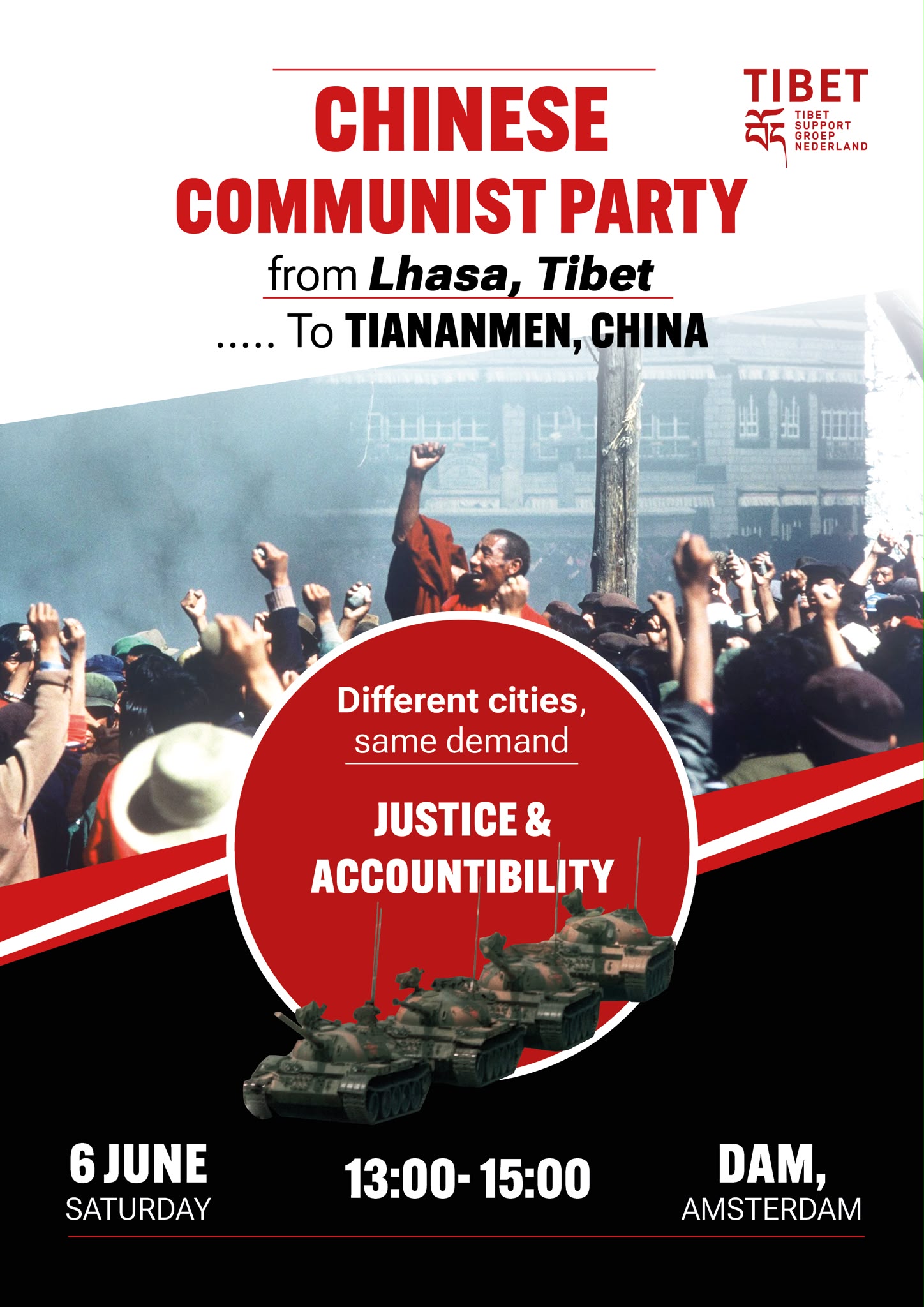 From Lhasa, Tibet to Tiananmen, China — different cities, the same demand: justice and accountability. Commemoration on Saturday 6 June, 13.00–15.00, at Dam Square in Amsterdam.
On Saturday 6 June, the Tibet Support Group Netherlands joins the commemoration of the Tiananmen Square massacre of 4 June 1989 — this year 37 years ago. We remember the thousands of people who stood up for democracy and freedom and paid for it with their lives, shot and crushed by the army of the Chinese Communist Party.
This commemoration is also held expressly in remembrance of what happened just months earlier, in March and April 1989, in Lhasa and other parts of Tibet — the events that preceded Tiananmen. In doing so we also honour the hundreds of Tibetans who lost their lives. Different cities, the same crime, the same perpetrator.
Come and join us if you are able — to commemorate this unimaginable crime and to honour the victims who stood up for democracy and freedom.
Lhasa, March 1989: the dress rehearsal
What the world watched unfold in Beijing in June 1989 had already been tested by Beijing months earlier in Tibet — out of the world’s sight. In early March 1989, monks, nuns and Tibetan civilians marched peacefully around the Barkor in Lhasa, carrying the Tibetan flag and chanting for freedom. The state’s response was lethal: armed police opened fire on unarmed demonstrators and bystanders.
On 7 March, Premier Li Peng signed the order imposing martial law in Lhasa — the first time in the history of the People’s Republic that a state of emergency was declared. More than a thousand heavily armed troops moved into the city. Within days foreigners were expelled and Lhasa was sealed off completely, leaving almost no independent witnesses.
It is precisely that lockdown that explains why the death tolls remain disputed to this day. Official Chinese figures ranged from ten to sixteen dead; doctors spoke of around thirty; Amnesty International recorded unofficial reports of at least sixty civilians killed, and later testimony from a Chinese journalist alleged hundreds of Tibetan deaths. What is certain is that Beijing has never provided full transparency. Martial law in Lhasa would not be lifted until 1 May 1990 — thirteen months of military occupation, mass arrests, torture and arbitrary detention.
Tiananmen, June 1989: the world watches
In Beijing, following the death of Hu Yaobang on 15 April, a movement of students, workers, journalists and ordinary citizens grew, calling for an end to corruption, for press freedom and for political accountability. The occupation of the square, the hunger strike and the image of the Goddess of Democracy became world news.
On the night of 3 to 4 June, the army brought it to a bloody end. Tanks and armoured vehicles forced their way to the square; soldiers fired on unarmed civilians, including on approach roads such as Muxidi and even after the square had already been cleared. The Chinese government publicly put the toll at roughly 200 to 300 dead, soldiers included. Amnesty International called this a gross underestimate and estimated that at least a thousand civilians were killed. A full, public accounting has — just as with Lhasa — never been given.
One logic, two massacres
Lhasa and Tiananmen were different crises, with different grievances: Tibetan resistance to Chinese domination versus a call for reform at the very heart of power. But the hand that carried out the violence was the same. In both cases the party-state recast peaceful protest as “rioting” or “splittism”, declared martial law, opened fire on unarmed people, shut out the outside world and then erased the memory. Lhasa was, in method if not in scale, the dress rehearsal for Beijing.
Nearly forty years on, the Chinese Communist Party still refuses any form of accountability. In China, even the memory of 4 June is banned; the victims of Lhasa are written out of the official narrative altogether. That is why we keep commemorating — because silence is exactly what Beijing wants.
Demonstration: Saturday 6 June at Dam Square
The Tibet Support Group Netherlands calls on everyone to be present and to demand, together with us, justice and accountability for the victims of both Lhasa and Tiananmen.
- When: Saturday 6 June 2026, 13.00–15.00
- Where: Dam Square, Amsterdam
Different cities, the same demand: justice and accountability.
Sources
- Amnesty International – People's Republic of China: Preliminary findings on killings of unarmed civilians (June 1989)
- Asia Watch – Merciless Repression: Human Rights in Tibet
- Human Rights Watch – China: Tiananmen's Unhealed Wounds
- International Campaign for Tibet – 1989 martial law in Lhasa
- Reuters – Timeline: China's 1989 Tiananmen Square protests